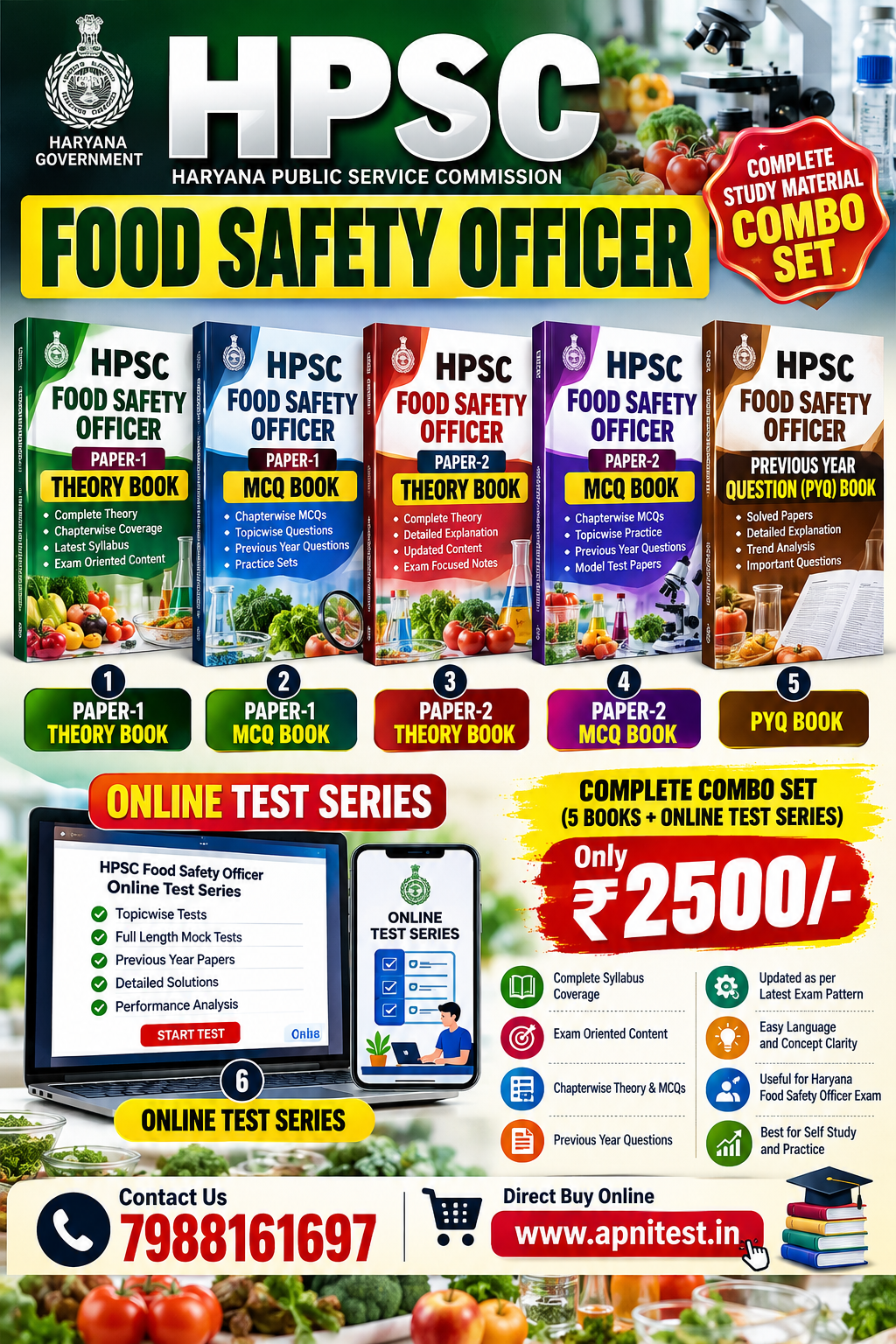
HPSC FOOD SAFETY OFFICER SYLLABUS PATTERN TEST SERIES BOOK 2026
HPSC FSO Exam Pattern 2026
The HPSC Food Safety Officer Detail Exam Pattern are as follows:
| Parameter | Stage 1: Screening Test (If Conducted) | Stage 2: Subject Knowledge Test | Stage 3: Interview / Viva-Voce |
|---|---|---|---|
| Type of Questions | Objective (Multiple Choice Questions) | Conventional / Descriptive Answer Writing | Verbal / Personality Assessment |
| Total Marks | 100 Marks | 150 Marks | 12.5% of Overall Score |
| Duration | 2 Hours (120 Minutes) | 3 Hours (180 Minutes) | N/A |
| Medium of Exam | English & Hindi | English | English / Hindi |
| Negative Marking | 0.25 Marks deducted per wrong answer | N/A | N/A |
| Qualifying Cut-off | Minimum 25% to qualify for shortlisting | Minimum 35% to qualify for Interview | N/A |
| Merit Weightage | Qualifying only (Marks not counted in final merit) | 87.5% Weightage towards final selection | 12.5% Weightage towards final selection |
HPSC Food Safety Officer Detailed Syllabus Breakdown
The syllabus covers both foundational food sciences and regulatory standards defined under Indian law.
1. Food Safety & Regulatory Acts
- Food Safety and Standards Act (FSSA), 2006: History, provisions, rules, and mandatory standards.
- Regulatory Bodies: Functions and duties of FSSAI, State Food Safety Authorities, and Central Advisory Committee.
- Food Testing & Laboratories: Enforcement, sampling procedures, public analysts, food safety officers’ duties, legal powers, and search/seizure protocols.
- International Standards: Codex Alimentarius Commission (CAC), ISO 22000, WTO-SPS and TBT agreements.
2. Food Chemistry & Nutrition
- Carbohydrates, Proteins, and Lipids: Classification, structure, functional properties, and chemical changes during processing.
- Vitamins, Minerals, and Pigments: Occurrences, bioavailability, loss during processing, and biological functions.
- Enzymes: Classification, kinetics, application in food processing, and enzymatic spoilage.
- Food Additives & Contaminants: Preservatives, colorants, emulsifiers, flavor enhancers, heavy metals, pesticide residues, and adulterants.
3. Food Microbiology & Safety
- Microorganisms in Food: Bacteria, yeasts, molds, and viruses associated with food systems.
- Foodborne Illnesses: Infection vs. intoxication, pathogens (Salmonella, E. coli, Listeria, Clostridium), and symptoms.
- Contamination & Hygiene: Sources of contamination, cleaning and sanitation (CIP/COP), personal hygiene, and water quality.
- Preservation Principles: Thermal processing, freezing, dehydration, irradiation, chemical preservation, and high-pressure processing.
4. Food Processing & Packaging Technology
- Processing Operations: Unit operations in agricultural and animal product processing (milling, extraction, pasteurization, sterilization).
- Dairy & Meat Technology: Milk processing, cheese, butter, meat preservation, poultry, and seafood processing.
- Packaging Materials: Glass, metals, plastics, biodegradable materials, active and intelligent packaging.
- Quality Assurance Systems: HACCP (Hazard Analysis Critical Control Point), GMP (Good Manufacturing Practices), and GHP (Good Hygiene Practices).
5. Haryana General Knowledge & Current Aptitude
(Applicable primarily for the Screening Stage)
- Haryana Specifics: Geography, economy, history, administrative structure, and state agricultural practices.
- General Aptitude: Logical reasoning, basic quantitative ability, data interpretation, and national/international current events.
HPSC FOOD SAFETY OFFICER BOOK COMBO BUY LINK-#https://www.apnitest.in/shop/hpsc-food-safety-officer-books-combo-5-book-and-online-test-series-620